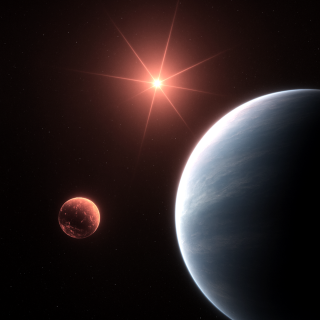

Sub-Neptunes - planets larger than Earth but smaller than Neptune - are the most common type of planet in our Galaxy, yet they are entirely absent from our own Solar System. This absence makes them a major focus for astronomers seeking to understand planetary formation and evolution. We recently conducted an international study, as part of the THIRSTEE project, to characterize two such planets orbiting very similar small, cool stars known as M dwarfs: TOI-521 and TOI-912.
THIRSTEE is an observational-based program that aims to shed light on the sub-Neptune population by providing an enlarged sample of precisely characterised planets, and combining their precise and accurate densities with atmospheric characterization and a novel statistical approach. The two systems analyzed in this work are part of the THIRSTEE M-dwarf sample, and have been characterized thanks to state-of-the-art instruments like the ESPRESSO spectrograph in Chile Paranal’s Observatory.
The two planets, TOI-521 b and TOI-912 b, are remarkably similar in their physical "bulk" properties. Both have a radius roughly twice that of Earth and a mass approximately five times greater. Despite these physical similarities, their orbital lives couldn't be more different. While TOI-521 b follows a circular path, TOI-912 bpossesses an unusually high eccentricity, making its orbit highly elongated and oval-shaped. This makes it one of the most eccentric sub-Neptunes discovered to date, suggesting a chaotic history, likely involving high-eccentricity migration, where the planet was pushed from a distant orbit toward its star.
A central question in exoplanetary science is whether these sub-Neptunes are "gas dwarfs" (rocky cores with thick hydrogen-helium atmospheres) or "water worlds" (composed of up to 50% water). The data for TOI-521 b and TOI-912 b place them in a "degenerate" region (see Figure 1) where both compositions are plausible. However, when compared to the other targets in the THIRSTEE program, these planets support the hypothesis of a density gap among M-dwarf planets, suggesting they belong to a population of volatile-rich worlds, distinct from the rocky, Earth-like one.
This work marks a significant step in the THIRSTEE project's mission to map the diverse landscape of the most abundant planets in the universe.